
NFL
Super Bowl History Shattered as George Strait and Alan Jackson Quiet the Loudest Stage in America, Leaving 100 Million Viewers Stunned by a Halftime Show With No Pyrotechnics, No Dancers, and No Apologies”

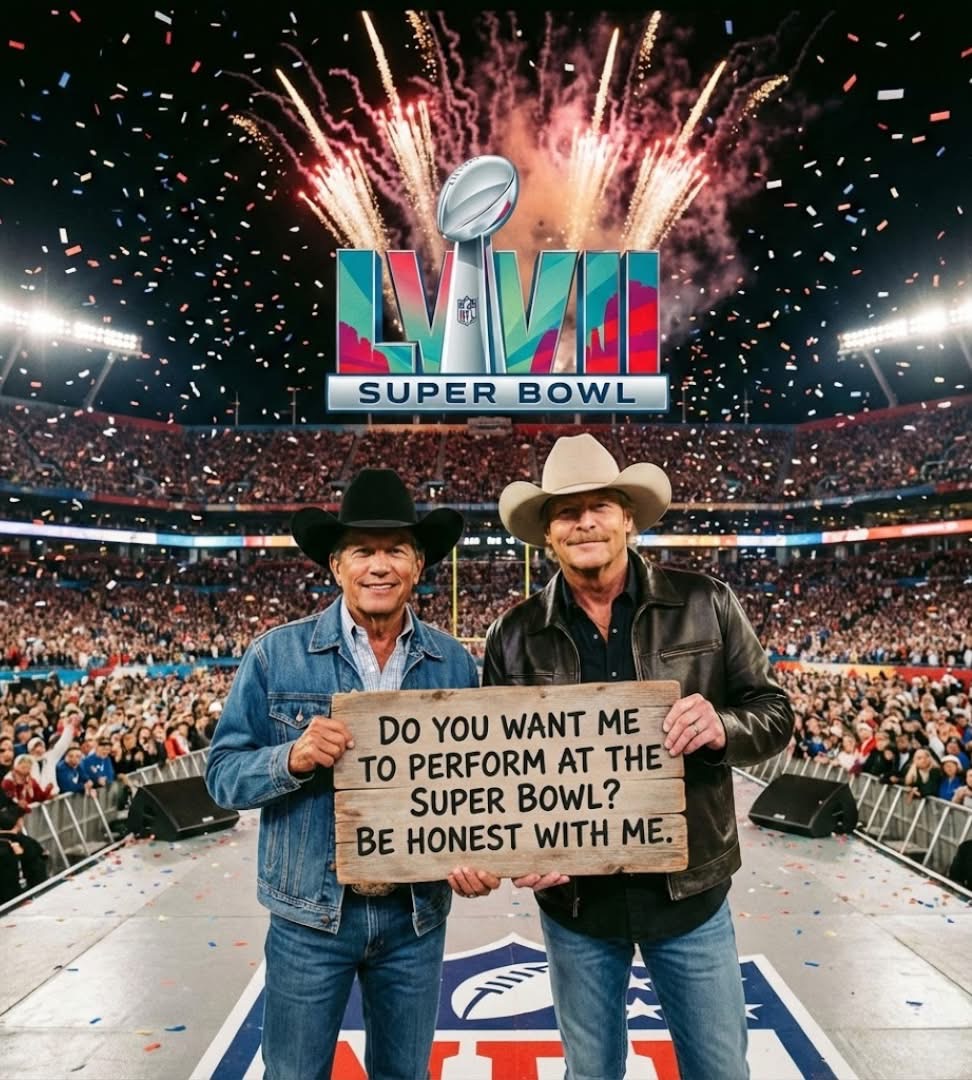
WHEN THE SPECTACLE FADES — AND THE KINGS OF COUNTRY TAKE THE FIELD
The Super Bowl has always thrived on thunder.
Pyrotechnics clawing the night sky.
Lasers slicing through the roar.
Performers chasing the next viral explosion.
But every so often, something profounder breaks through.
The frenzy quiets.
The moment yields to timelessness.
This year, for the first time in history, George Strait and Alan Jackson share the Super Bowl halftime stage. Not as a gimmick. Not as a pop crossover. But as the unwavering guardians of a sound that has outlasted every flash-in-the-pan trend that tried to eclipse it.
When they step out, the stadium won’t explode.
It will exhale.
For over four decades, George Strait has been country music’s fixed star. The spotlight never chased him—he simply let it find its place. His voice doesn’t demand attention; it commands reverence. “Amarillo by Morning” still feels like quiet defiance wrapped in steel guitar. “Check Yes or No” folds decades into a single note, making strangers feel like kids again.
George Strait doesn’t sing songs.
He preserves them.
Standing tall beside him is Alan Jackson the gentle chronicler of ordinary lives made extraordinary. The man who turned small-town truths into anthems without ever needing bigger metaphors than a porch swing or a dusty road. “Remember When” doesn’t perform for a crowd; it stills one. “Chattahoochee” summons summers long gone. And “Where Were You (When the World Stopped Turning)” captured a nation’s grief with grace no one else could touch.
Jackson doesn’t force feeling.
He simply clears space for it to arrive.
Together, they aren’t a pairing.
They are the last pure flame of traditional country.
When the industry veered toward gloss, hooks, and volume, these two held the line. They sang for tailgates and taverns, for first dances and final farewells, for long hauls down forgotten highways. Their records didn’t beg to be timeless, they became the very fabric of memory.
So when the lights drop and over a hundred million souls settle into a rare, shared hush, this halftime will stand apart from any in recent memory.
No elaborate choreography.
No blinding effects.
No desperate bid for trending clips.
Just two acoustic guitars.
Two voices forged in honky-tonks and heartbreak.
And the sound of a nation rediscovering its roots.
Imagine it: Strait’s resolute baritone weaving with Jackson’s warm Georgia drawl. Harmonies rising like smoke from a late-night campfire not manufactured, but earned over lifetimes. The crowd swaying not because they’re told to, but because some songs reach straight into muscle memory.
This isn’t mere collaboration.
It isn’t nostalgia bait.
It isn’t even a performance in the modern sense.
It’s communion.
A quiet acknowledgment that the truest music doesn’t chase eras, it defines them. That honesty outlives hype. That tradition, carried with integrity, doesn’t fight change… it endures beyond it.
For twelve unforgettable minutes, the Super Bowl won’t just entertain a global audience.
It will remind America and the world what real country sounds like when the noise finally falls away.
And when the last chord lingers, when the stadium lights blaze back on and the second half kicks off, something irreversible will have happened.
Because George Strait and Alan Jackson won’t just have played the field.
They’ll have reclaimed it for every fan who ever slow-danced in a gravel parking lot, cried on a backroad, or found solace in a three-minute story told straight.
Years from now, when the debates rage over the greatest halftime shows of all time, this one won’t require argument.
It will simply be remembered as the night the Kings returned, and country music spoke clearest when it said the least.

The U.S. Department of Transportation (DOT) has announced that it will withhold $40.6 million in federal funding from California, citing the state’s failure to fully enforce a rule requiring commercial truck drivers to demonstrate English proficiency. According to federal law, truck drivers must be able to read road signs, respond to official inquiries, and complete paperwork in English. The DOT argues that California’s existing licensing system does not adequately ensure that all drivers meet these requirements. In response, California officials assert that their system already complies with federal standards. This penalty affects California’s ability to receive reimbursements for truck safety programs, including inspections and enforcement activities, under the Motor Carrier Safety Assistance Program.

Newsom Defies Federal Law: California Risks $160 Million in Federal Funds Over Trucking Licenses California Governor Gavin Newsom is facing a showdown with federal authorities after the state DMV unilaterally extended the deadline for revoking 17,000 commercial driver’s licenses held by foreign nationals. Transportation Secretary Sean Duffy blasted the extension as illegal, warning that if California doesn’t revoke the licenses by January 5, it could lose nearly $160 million in vital federal highway funds. As Newsom continues to push policies that defy federal laws, Californians may soon pay the price, with federal funds at risk and public safety concerns growing. This is just another example of Newsom’s reckless governance putting the state in jeopardy.

UKRAINE 2022. VENEZUELA 2026. Elon Musk Once Again Deploys Starlink as Conflict Shuts Down a Nation 🧠 Is tech neutrality officially dead? Read and decide

VENEZUELA GOES DARK — STARLINK GOES LIVE: Musk Confirms Free Internet Amid Power Cuts and Political Upheaval 🔥 Lifeline or leverage? The debate is exploding — join it

UNPRECEDENTED MOVE: Allies Turn on America as Trump’s Venezuela Operation Triggers Article 5 Fallout 📌 What happens when the world’s strongest alliance fractures? Read now

“We have taken in, and will soon be receiving, more than 600 Billion Dollars in Tariffs, but the Fake News Media refuses to talk about it because they hate and disrespect our Country… our Country is financially, AND FROM A NATIONAL SECURITY STANDPOINT, FAR STRONGER AND MORE RESPECTED THAN EVER BEFORE.” – President Donald J. Trump 🇺🇸

Dear Mr President Donald J. Trump Donald J. Trump We the People of the United States demand the arrest of Hakeem Jeffries for treason. His actions by contacting Venezuela even though it was too late could have cost the lives of our men and women that were involved in this mission. By law this is treason when you turn on your government. ARREST HIM ASAP!!!!!

“WORLD STUNNED: President Trump Declares ‘Peace on Earth’ as Official New Year’s Resolution—Insiders Claim Secret Global Ceasefire Talks, Military Stand-Down Orders, and a Radical ‘America First, World Peace Always’ Doctrine Are Already Underway”

President Trump’s proposal to revoke green cards and visas of Hamas supporters directly targets foreign nationals who fund or promote terrorist activities against the United States and its allies. Allowing such individuals to remain in the country poses a serious threat to national security, public safety, and American families. Deporting them reinforces that the U.S. will not tolerate support for violent extremist organizations on its soil. Do you support this?

Donald Trump & Melania Trump 🇺🇸✨❤️ A partnership that has lived under the world’s brightest spotlight — Donald Trump and Melania Trump represent one of the most talked-about couples in modern global history. Their journey is not just about power and politics, but about contrast, resilience, and standing firm amid constant scrutiny. Together, they became symbols of a controversial era, admired by supporters, questioned by critics, yet impossible to ignore.

JUST IN: President Trump ordered a “powerful and deadly strike” against ISIS militants in northwest Nigeria following attacks on Christian communities. “Under my leadership, our Country will not allow Radical Islamic Terrorism to prosper.”
