
NEWS
The U.S. Department of Transportation (DOT) has announced that it will withhold $40.6 million in federal funding from California, citing the state’s failure to fully enforce a rule requiring commercial truck drivers to demonstrate English proficiency. According to federal law, truck drivers must be able to read road signs, respond to official inquiries, and complete paperwork in English. The DOT argues that California’s existing licensing system does not adequately ensure that all drivers meet these requirements. In response, California officials assert that their system already complies with federal standards. This penalty affects California’s ability to receive reimbursements for truck safety programs, including inspections and enforcement activities, under the Motor Carrier Safety Assistance Program.

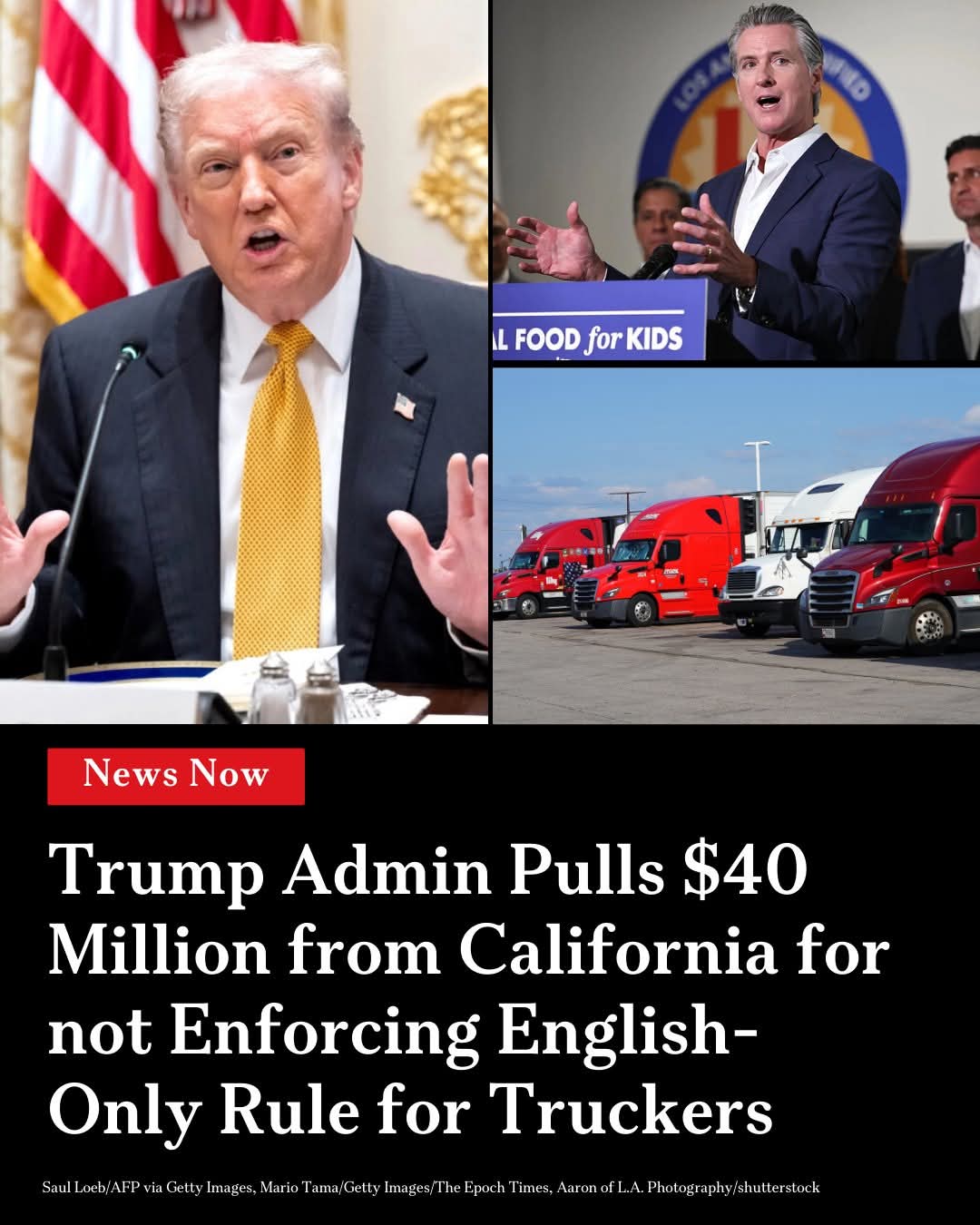
Here’s a more detailed and up-to-date account of the federal funding dispute between the U.S. Department of Transportation (DOT) and California over enforcement of English proficiency requirements for commercial truck drivers:
—
📌 What the Federal Government Says
1. Federal Regulation Background
Under Federal Motor Carrier Safety Administration (FMCSA) rules — specifically 49 C.F.R. § 391.11(b)(2) — all commercial motor vehicle (CMV) drivers are required to:
Read and speak English sufficiently to converse with the public,
Understand highway traffic signs and signals in English,
Respond to official inquiries, and
Make entries on reports and records.
In April 2025, President Trump issued an executive order directing stronger enforcement of these English language proficiency (ELP) standards. This rescinded a less strict 2016 policy that discouraged placing drivers out of service for ELP violations.
2. Non-Conformity Finding & Funding Pull
The FMCSA found that California’s current enforcement does not adequately implement the federal ELP requirement — particularly that inspectors must assess and take action at roadside inspections when drivers fail the standard. Because of this, FMCSA withdrew approval of California’s Commercial Vehicle Safety Plans for FY 2024 and 2025. As a result, California will not be reimbursed for any Motor Carrier Safety Assistance Program (MCSAP) spending after October 15, 2025 until the state adopts and enforces a law compatible with the federal rule.
The withheld amount — roughly $40.6 million — comes from federal grants that reimburse the state for safety programs such as roadside inspections, truck safety audits, enforcement activities, and public education campaigns.
Secretary of Transportation Sean Duffy stated publicly that California is “the only state in the nation that refuses to ensure big rig drivers can read our road signs and communicate with law enforcement.”
—
⚖️ California’s Position & Legal Pushback
1. Compliance Claim
California argues it already enforces English proficiency as part of its commercial licensing:
The state’s commercial road test must be administered entirely in English,
Interpreters are not allowed during the skills test, and
State law bars issuance or renewal of a commercial driver’s license to anyone unable “to read and understand simple English used in highway traffic and directional signs.”
California officials have asserted these measures satisfy federal standards and that there is no explicit federal requirement that drivers be tested for English proficiency during roadside inspections.
2. Lawsuit Challenging the Withholding
In December 2025, the state filed a lawsuit against DOT, FMCSA, and Secretary Duffy — claiming the funding cut is “arbitrary and capricious,” threatens public safety, and lacks legal basis. California also points to data showing its commercial drivers have lower fatal crash rates than the national average.
—
🔥 Broader Context & Related Actions
1. CDL Revocations & Broader Enforcement Pressure
The dispute ties into broader federal pressure on California over commercial driver licenses issued to non-U.S. citizens. In late 2025, a federal audit identified about 17,000 non-domiciled CDLs that didn’t comply with verification standards. California planned to revoke these licenses, though a lawsuit by immigrant advocacy groups has delayed that process until March 2026. U.S. DOT warned that failure to meet compliance deadlines could cost California up to an additional $160 million in funding.
2. National Policy Trend
DOT also notified Washington state and New Mexico about similar ELP enforcement deficiencies earlier and threatened funding cuts if those states do not adopt compatible enforcement.
—
🛣️ Why This Matters
Safety: Federal officials argue that English proficiency is essential for safe operation of large trucks — especially for understanding signs and communicating with law enforcement at roadside inspections.
Federal vs. State Authority: The conflict highlights a broader tension over how federal safety standards should be implemented at the state level, especially when state laws appear to cover similar ground in different ways.
Political Dynamics: The issue intersects with national debates over immigration, language policy, and federal funding priorities, drawing criticism and support across political lines.

The U.S. Department of Transportation (DOT) has announced that it will withhold $40.6 million in federal funding from California, citing the state’s failure to fully enforce a rule requiring commercial truck drivers to demonstrate English proficiency. According to federal law, truck drivers must be able to read road signs, respond to official inquiries, and complete paperwork in English. The DOT argues that California’s existing licensing system does not adequately ensure that all drivers meet these requirements. In response, California officials assert that their system already complies with federal standards. This penalty affects California’s ability to receive reimbursements for truck safety programs, including inspections and enforcement activities, under the Motor Carrier Safety Assistance Program.

Newsom Defies Federal Law: California Risks $160 Million in Federal Funds Over Trucking Licenses California Governor Gavin Newsom is facing a showdown with federal authorities after the state DMV unilaterally extended the deadline for revoking 17,000 commercial driver’s licenses held by foreign nationals. Transportation Secretary Sean Duffy blasted the extension as illegal, warning that if California doesn’t revoke the licenses by January 5, it could lose nearly $160 million in vital federal highway funds. As Newsom continues to push policies that defy federal laws, Californians may soon pay the price, with federal funds at risk and public safety concerns growing. This is just another example of Newsom’s reckless governance putting the state in jeopardy.

UKRAINE 2022. VENEZUELA 2026. Elon Musk Once Again Deploys Starlink as Conflict Shuts Down a Nation 🧠 Is tech neutrality officially dead? Read and decide

VENEZUELA GOES DARK — STARLINK GOES LIVE: Musk Confirms Free Internet Amid Power Cuts and Political Upheaval 🔥 Lifeline or leverage? The debate is exploding — join it

UNPRECEDENTED MOVE: Allies Turn on America as Trump’s Venezuela Operation Triggers Article 5 Fallout 📌 What happens when the world’s strongest alliance fractures? Read now

“We have taken in, and will soon be receiving, more than 600 Billion Dollars in Tariffs, but the Fake News Media refuses to talk about it because they hate and disrespect our Country… our Country is financially, AND FROM A NATIONAL SECURITY STANDPOINT, FAR STRONGER AND MORE RESPECTED THAN EVER BEFORE.” – President Donald J. Trump 🇺🇸

Dear Mr President Donald J. Trump Donald J. Trump We the People of the United States demand the arrest of Hakeem Jeffries for treason. His actions by contacting Venezuela even though it was too late could have cost the lives of our men and women that were involved in this mission. By law this is treason when you turn on your government. ARREST HIM ASAP!!!!!

“WORLD STUNNED: President Trump Declares ‘Peace on Earth’ as Official New Year’s Resolution—Insiders Claim Secret Global Ceasefire Talks, Military Stand-Down Orders, and a Radical ‘America First, World Peace Always’ Doctrine Are Already Underway”

President Trump’s proposal to revoke green cards and visas of Hamas supporters directly targets foreign nationals who fund or promote terrorist activities against the United States and its allies. Allowing such individuals to remain in the country poses a serious threat to national security, public safety, and American families. Deporting them reinforces that the U.S. will not tolerate support for violent extremist organizations on its soil. Do you support this?

Donald Trump & Melania Trump 🇺🇸✨❤️ A partnership that has lived under the world’s brightest spotlight — Donald Trump and Melania Trump represent one of the most talked-about couples in modern global history. Their journey is not just about power and politics, but about contrast, resilience, and standing firm amid constant scrutiny. Together, they became symbols of a controversial era, admired by supporters, questioned by critics, yet impossible to ignore.

JUST IN: President Trump ordered a “powerful and deadly strike” against ISIS militants in northwest Nigeria following attacks on Christian communities. “Under my leadership, our Country will not allow Radical Islamic Terrorism to prosper.”
